(It has been a while, my friends…here´s an introduction to an insight of what Food is up to in Extremadura, Spain)
Dehesa is a multifunctional agro-sylvo-pastoral system (a type of agroforestry) and cultural landscape of southern and central Spain and southern Portugal, where it is known as montado.[1] Dehesas may be private or communal property (usually belonging to the municipality). Used primarily for grazing, they produce a variety of products including non-timber forest products such as wild game, mushrooms, honey, cork, and firewood. The tree component is oaks, usually holm (Quercus ilex) and cork (Quercus suber). Other oaks, including Melojo (Quercus pyrenaica) and Quejigo (Quercus faginea), may be used to form dehesa, the species depending on geographical location and elevation. Dehesa is an anthropogenic system that provides not only a variety of foods, but also wildlife habitat for endangered species such as theIberian lynx and the Spanish imperial eagle.[2] —>That’s what Wikipedia had to say about the Dehesa.
Pig-stuff. Huckleberry saw the word dehesa everywhere, advertising restaurants and stores that sell regional products. That meant one could get hammed up on what ever (ham on whole wheat excluded) pig product imaginable. Near Thanksgiving, there is an event in Extremadura called La Matanza. (La matanza 1, la matanza 2 – don´t translate it, just take a peruse through the Spanish Wiki, it is very different from what you´ll get in English) Anything and everything that requires cleaning the pigs EVERYTHING (who knows, maybe its yourn turn to clean out the intestines this year o.O ) ..yes, there isn´t much to waste from these domestic pig slaughters. Industrially, there are repercussions in delicious abundance. No, you won´t find specially salted and spiced cured meats, but the cured meats you will find are certainly distinct. Further, sometimes a good cut of Jamon Iberico..really is all it is hyped to be. Jamon Ibérico de Bellota is supposedly a free-range acorn and herb diet dehesa exercised source of 36 month cured meat. Like all food systems and regulations, the veracity of its source honoring all such requirements was in quetion (i.e. not feeding a ton of penned up caged piggies acorns in the last period to fatty up the wallets of men who don´t actually do labor). Even so, Huckleberry has been more than impressed often with the quality of straight up Jamon Ibérico de Bellota, even if it is a bit pricey for his budget – and blood cholesterol. (Grades of Jamón Ibérico are: Bellota, Recebo, and Cebo: – depending on the purity of diet (acorns!) and duration of curation.)
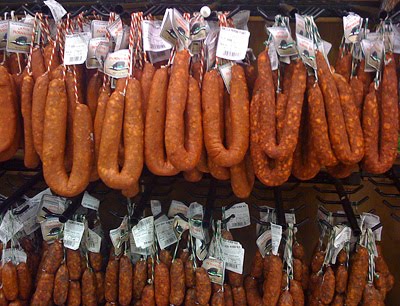
Beyond the famous Iberian Ham from the extremaduran region, Huckleberry enjoyed an inicially overwhelming amount of cured meat varieties just hanging out every two blocks. In regards to pursual of beyond par quality products, there was no variation, exploration, competitive difference between different productions of cured meats – and thus every store more or less sold the same product. All things considered though, the run of the mill was pretty damn good.
Bread. Huckleberry´s tears could ferment and bake into better bread. Moving on.
Cheeeeeeeez. Yes, in the first two months of living in this dehesa driven Extremaduran Cacereñan province capital city, it became apparent that there was some good cheese to get down on. Lots of sheep cheeses cheesed out through all the god given varieties cheese may cheese out into. All the soft, hard, sweet, bitter and lovely inbetweens could be savoured. By far the most famous cheese of the region is the Torta del Casar.
The Torta del Casar is like a swollen hockey puck of sharp, yeasty, stinky, (therefore delicious) creamy and very spreadable cheese. They advise storing it in the fridge, taking it out several minutes before serving and cutting off the top as if you were scalping the poor thing. Then you place the scalped rind loosley on top like an askew pothole cover for the stinky city sewers. This allows the cheese to achieve a certain moist texture before it punches your palate with its bitter advance. This may sound a bit, overwhelming, but its actually quite, quite satisfyingly delicious. (Watch this 10 minute video made by the Junta de Extremadura to find out just how serious this cheese is)
Chorizo. “Once,” Huckleberry committed the heinous crime of using a cured, bloody chorizo and cut it into long slices for breakfast bacon. Shh. Don´t tell the purists.
Keep it secret, keep it safe.
Quote courtesy of Gandalf the Grey.
Wine, Wine, Wine. Growing up, everyonce in a while a mysteriously named, “The Wine Guy” would arrive at Huckleberry´s home. Then his parents would taste test wines from “The Wine Guy”´s fermented wonder filled treasure chests. This was a good precedent for a young Huckleberry. The pleasure of boozing is in the choosing. While, yes, one could go through life buying Tempranillos of the Rioja without woooah this sentence is already way too boring.
Spain actually has a great deal of interesting wines that are hard to hear of, often cheap and, “thanks” to the terrible economy as of many-a-year, have no choice but to break tradition and try.. new things.
Now, narratively speaking, I love you Spain – but sometimes your excesively traditional and extremely conservative ways just make me want to did I mention that there are better things to do in life, like try different grapes forged in varying valleys and terrains? Now, Extremadura isn´t the queen on the chess board of Spain´s wine industry, but the Ribera Del Guadiana (Denominación de Origen) produces some pretty great wines. There are at least 29 different grapes grown here, and that´s plenty enough to get a sense of things. Just like the ham here, the average glass of Extremaduran wine is higly satisfactory. There´s a fun, one might even venture to say hip, winery called HABLA 40 minutes from Cáceres. Their wines aren´t expensive but taste like they could be, should the company so desire. They have a numerated series of wines, as well as two others: habla del silencio (speak of silence), habla de la tierra (speak of the land).
Wild mushrooms. Perusing the shelves of the local library upon arrival in Cáceres, Huckleberry noticed many a book on hunting wild mushrooms in Extremadura. It was going to be a good trip. So far, the most commonly prepared local wild mushroom is the Boletus.
Sweets. Chicharron Scones! Mazapan! It turns out, there´s a fantastic pastry shop across the street from Huck´s apartment. Another pastry shop just behind the building. Another on the way to school, and another if he is also on the way to school but the taking other way to school. There are a lot of fun pastries here, which will require a whole nother helping of blogg. The Christmas season bounty of marzipan treats rocked Huckleberry´s sweet little universe day in day out. Bon Bons, truffles, “insert delicious here” doughy pastries, Almond and wine cooked honey gem lodged cookies, Polvorón lemon shortbreads. Yes, I will stop.
Coffee. Everyday, Huckleberry dies a little drinking what is apparently coffee. Still, he wonders…somewhere out there…
Potatoes. Wherever there are poor people, you will find a plethora of potatoes – or so they say here, repeatedly. Extremadura is one of the least densely populated regions of Spain, and has a pretty low GDP. There are potatoes everywhere. This, one might think, could lead to all sorts of delicious potatoe dishes. Nope. Spain might just take the cake for unjustified public abuse with constant onslaughts of fried tatters or frozen totts thrown into a microwave only to be thrown into a shallow ceramic pit with now lukewarm olive oil. Old potatoes are turned into a, “Russian (potato) salad”. Huckleberry was initially astounded when he arrived, after four years time, to find that every beverage and meal at a bar or restaurant came with a crispy insult fried in irony – paying the equivalent of 12 dollars for a meal should exclude the possibility of receiving corporate supplied french fries or bagged potato chips. They sell 8 dollar plates of thawed then fried potato bits, smothered in mayonaise and in ketchup. Apparently it´s spicy. #youthoughtthemidwestwasbland
But, there is hope, my friends. Huckleberry hasn´t completely thrown in the towel to clean up the mess of potato fails in Spain..there is of course the Spanish Tortilla. If you haven´t heard of it, imagine an omlette that was, instead, a breakfast egg cake. No, no, that sounds terrible. Instead imagine, tell you what, it´s really simple. All you need is an equal ratio of small potatoes to eggs, onion, salt and olive oil. Thinly slice the potatoes and onions, fry them with a couple dashes of salt and when they are oh so tasty lookin´separate them from the oil. Add them to the salted, beaten eggs in a bowl and stir up a sloppy bowl of breakfast goop. Fry the goop in a new pan with a little oil. Like the thickest, most unnatural pancake in the world, it will start to cook through and then you cover the pan with a plate, flip everything over, and then slide the eggy monstrosity back in the pan to finish cooking from the other side. Salt, Fat, Starch. It´s impossible not to finish satisfied.
Fruit. In Spain one can grow all kinds of fantastic citrus fruits, and one is hard pressed not to see a lemon, orange, grapefruit, or pomegranate tree in everyday meanderings. In Extremadura, where Huckleberry lives, one could also find cherries and the Japanese Persimmon fruit. Thanks to the sunny days and semi-mountainous terrains of Andalucía, Extremadura, and Almería – Spain has the luck of growing its very own Kaki´s (Caqui´s). All sorts of fun fruits grow here, but it is quite obvious that much of it is either green housed or chemically superpowered. Both dates and figs are really common and dried or candied varieties of each are often the very stuff of carnal temptation.
Cocido Extremeño (1, 2) It includes beef, chicken, ham, cured sausage, chorizo and sometimes cod. From the murky soup one scoops out heaps of cooked garbanzo beans. There might be leeks, carrots, peppers, onions, cod fish, one fish, two fish, whatever you have on you and, oh, some laurel leaves. A 3 courses in 1 preparation dish.
Pimenton! After sacking Rome of the Americas, the Spanish brought back a bunch of food. One of those beauties was red pepper. Pimenton, or smoked sweet red pepper powder, is a staple kitchen ingredient in homes and restaurants, and it´s made right here in Extremadura.
Turron. Sorry, I lied – it didn´t end there. Soft, white turron is like a [cakey, blanded crunchy-peanut-butter mixed with honey] paste that comes in blocks…except made with toasted almonds instead of peanuts. Its addictive potential is only outpowered by the sugar induced black out that will keep you from eating more.
Holy Tapas no, but Chicharron scone, awww yeah..

- Chicharron
My favourite at the moment is this scone called a chicharron. Chicharrones are made differently around the world, but here in Extremadura they are like scones made with Pig fat, parts of pig intestine (awww yeah), cinnamon, and very very mellow spices. It.Is.The.Cat´s.Meow.
Patatera
While the restaurants tend to serve pretty unremarkable tapas or pinchos..you can spend 3 euros and have a fantastic charcuterie experience at home. Goat cheese, sheep´s milk cheese, bovine delights of all varieties are easily bought and have all been exceptional in quality.
To accompany the cheese, like the vary famous Torta del Casar, I have had the pleasure of both Jamon Iberico and Extremadura´s very own Patatera.
Patatera is a spreadable sausage made with potatoes that comes in a spicy variety and a sweet variety. It looks like this!
- Patatera!


